





RFQ
Privacy statement: Your privacy is very important to Us. Our company promises not to disclose your personal information to any external company with out your explicit permission.
To address crimping burrs, the first step is to carefully inspect the crimped terminal appearance using specialized crimp quality inspection tools (such as cross-section gauges or high-magnification microscopes), paying special attention to the edges of the crimping area.
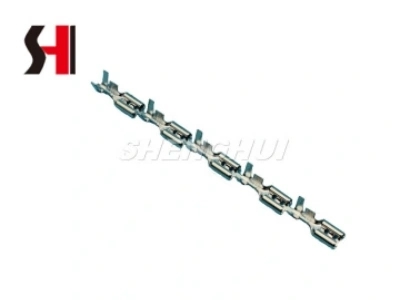
Tip: Once burrs are detected, they must be carefully trimmed with a specially designed fine file or deburring tool. Extra caution is required during operation—apply light and even pressure to avoid excessive trimming that could damage the terminal structure or weaken the metal strength in the crimped area. After trimming, perform another visual and cross-sectional inspection to confirm that the burrs have been completely removed and no new deformation has been introduced.
Additionally, selecting crimping dies that meet specifications and are in good condition, along with regular maintenance, is the fundamental measure to prevent the occurrence of crimping burrs. For copper and aluminum terminals, note their hardness differences. Crimping parameters (such as force and height) must be strictly set according to the terminal manufacturer’s specifications. Since aluminum is softer, improper parameters are more likely to cause burrs or deformation.

October 31, 2026

October 27, 2026
Connector, CONNECTOR. Domestically referred to as connectors, plugs and sockets. Generally refers to electrical connectors. That is, a device that connects two active devices to transmit current or...
The Connector connector is a plug-in part for current communication and disconnection. It contains a number of gold-plated pins as a positive part of the rooting in the hole in the board. On the...
Generally, the wire connectors are all connected in such a way that it can ensure that the wire connectors do not ignite or short-circuit, and the phenomenon of poor contact is the construction...
Board-to-board connectors (Board-to-board connectors) are the most powerful connector products in all connector product types. They are mainly used in power systems, communications networks,...
Email to this supplier
October 31, 2026
October 27, 2026
 Catalog
Privacy statement: Your privacy is very important to Us. Our company promises not to disclose your personal information to any external company with out your explicit permission.
Fill in more information so that we can get in touch with you faster
Privacy statement: Your privacy is very important to Us. Our company promises not to disclose your personal information to any external company with out your explicit permission.