


RFQ
Privacy statement: Your privacy is very important to Us. Our company promises not to disclose your personal information to any external company with out your explicit permission.

Why Crimp Quality Matters for Household Appliances Terminal Connectors
Crimp quality directly affects the reliability of a household appliances terminal connector. Even a well-designed terminal may perform poorly if the wire is not crimped correctly. Crimping mechanically joins a wire conductor to a metal terminal. A proper crimp creates a firm connection with low electrical resistance and good pull-out strength. If the crimp is too loose, the wire may move or separate from the terminal. If it is excessively compressed, conductor strands may be damaged. Both...

What Is a Floating Board To Board Connector
A floating board to board connector is designed to compensate for small alignment differences between two printed circuit boards during assembly. In real manufacturing, PCB positions are not always perfectly identical. Housing tolerances, screw positions, automated assembly, and dimensional variation can create slight misalignment between boards. With a completely rigid connector, these differences may cause difficult mating or additional mechanical stress. A floating connector solves this...

How Locking Structures Improve Wire To Wire Connector Reliability
The locking structure is an important feature of many wire to wire connectors. It helps keep the mating housings securely connected and prevents accidental separation during operation. When two connectors are mated, their terminals must remain correctly aligned and maintain stable contact pressure. If the housings become partially separated, electrical resistance may increase or signals may become intermittent. A properly designed locking mechanism helps prevent this problem. Common designs...

How Materials Affect Wire-to-Board Connector Performance
The performance of a wire-to-board connector depends not only on its design, but also on the materials used to make it. The metal terminals, surface plating, and insulating housing all influence conductivity, durability, and long-term reliability. For buyers and manufacturers, understanding these materials is important when selecting the right connector. The conductive terminals are usually made from copper alloy materials. These materials are chosen because they offer a good balance between...

How Does an Inductor Work in an Electronic Circuit?
An inductor works by generating a magnetic field when electrical current flows through its coil. When the current changes, the magnetic field also changes, creating a voltage that opposes the change in current. This principle is known as electromagnetic induction. When current increases, the inductor stores energy in its magnetic field. When current decreases, the stored energy is released back into the circuit. This behavior allows the inductor to smooth current changes and improve power...

Custom Wire Harness Solutions for Industrial Applications
A custom wire harness is designed according to the electrical, mechanical, and installation requirements of a specific product. Compared with standard wiring, it can be customized in wire length, connector type, terminal structure, circuit layout, insulation material, and protection method. Different industries have different wiring needs. Automotive wire harnesses must resist vibration, heat, oil, and long-term movement. Appliance wire harnesses require compact structure, stable insulation,...

Why Terminal Soft Sheath Matters in Wire Harness Design
A terminal soft sheath is an important protective component in wire harness design. It covers terminal connection areas while providing flexible insulation and mechanical protection. In wire harness systems, terminals may be exposed to vibration, cable movement, dust, and contact with nearby parts. A soft sheath helps isolate conductive areas and reduces the risk of short circuits or connection damage. Its flexibility is especially useful in compact assemblies. Unlike rigid covers, a terminal...

Why Crimp Quality Matters for Wire Harness Terminals
A reliable wire harness terminal depends heavily on crimp quality. Even when the terminal and wire are made from good materials, an incorrect crimp can increase electrical resistance, weaken mechanical strength, and shorten service life. What Is Terminal Crimping? Crimping mechanically compresses the terminal barrel around the stripped wire conductor. A correct crimp creates a tight, low-resistance connection without requiring solder. This process is widely used in automotive, appliance,...

How Terminal Hard Sheath Design Improves Connection Reliability
A Terminal Hard Sheath is more than a protective cover. Its structure can directly influence terminal positioning, insulation performance, and connection reliability. A well-designed sheath should match the terminal closely without making installation difficult. If the internal space is too large, the terminal may move during use. If it is too tight, insertion may become difficult or cause damage. Structural features such as guide slots, locking areas, protective walls, and wire entry openings...

How Are Terminal Connectors Manufactured?
Terminal connector manufacturing requires precise control because small dimensional or material differences can affect electrical contact, assembly, and long-term reliability. Production usually starts with the metal terminal. Copper alloys such as brass or phosphor bronze are commonly processed by precision stamping. Progressive dies cut, bend, and form metal strips into the required contact shape while maintaining consistent dimensions. After stamping, terminals may receive surface treatments...

Why Heat Resistance Matters in Household Appliances Terminal Connectors
Heat resistance is an important requirement for a household appliances terminal connector, especially when it is installed near motors, heaters, compressors, or power modules. Many appliances generate heat during normal operation. Ovens, air fryers, coffee machines, refrigerators, washing machines, and dishwashers may expose internal connectors to elevated temperatures for long periods. If the connector material cannot withstand these conditions, the housing may deform or lose insulation...

High-Speed Board To Board Connectors for PCB Design
As electronic devices process more data at higher speeds, reliable communication between printed circuit boards becomes increasingly important. A high-speed board to board connector provides a compact connection between PCBs while supporting stable signal transmission. Unlike basic low-speed connections, high-speed applications require careful control of signal integrity. Contact geometry, connector pitch, PCB routing, grounding, and impedance can all affect transmission quality. Poor connector...

Why Crimp Quality Matters in Wire To Wire Connectors
Crimp quality has a direct impact on the reliability of a wire to wire connector. Even when the connector housing and terminal are well designed, an incorrect crimp can lead to unstable contact, increased resistance, overheating, or wire pullout. A crimp connection is formed by compressing a metal terminal around the conductor. In many designs, a second section grips the wire insulation to provide strain relief. When the crimp is correct, it creates a stable electrical path while keeping the...

Wire-to-Board Connector Pitch and Current Guide
When selecting a wire-to-board connector, some specifications matter more than others. Among the most important are pitch, current rating, and contact design. These three factors directly affect connector performance, product safety, and long-term stability. Pitch refers to the spacing between adjacent contacts. It influences how compact the connector can be and how easy it is to handle during assembly. Smaller pitch connectors are suitable for products with limited space, but they usually...

An inductor is a passive electronic component that stores energy in a magnetic field when current flows through it. It is widely used in power supplies, communication equipment, automotive electronics, industrial systems, household appliances, and consumer devices. Most inductors consist of a conductive winding and a magnetic core. Common core materials include ferrite, powdered iron, and metal composite materials. The design of the winding and core determines key characteristics such as...

How Does a Wire Harness Work in Electrical Equipment?
A wire harness works by connecting different electrical components through a structured wiring system. It allows power, signals, or data to move safely between parts such as sensors, switches, motors, lights, control units, and circuit boards. Each wire in the harness has a specific function. Some wires carry current, some transmit signals, and others provide grounding. These wires are cut to the required length, stripped, crimped with terminals, and assembled with suitable...
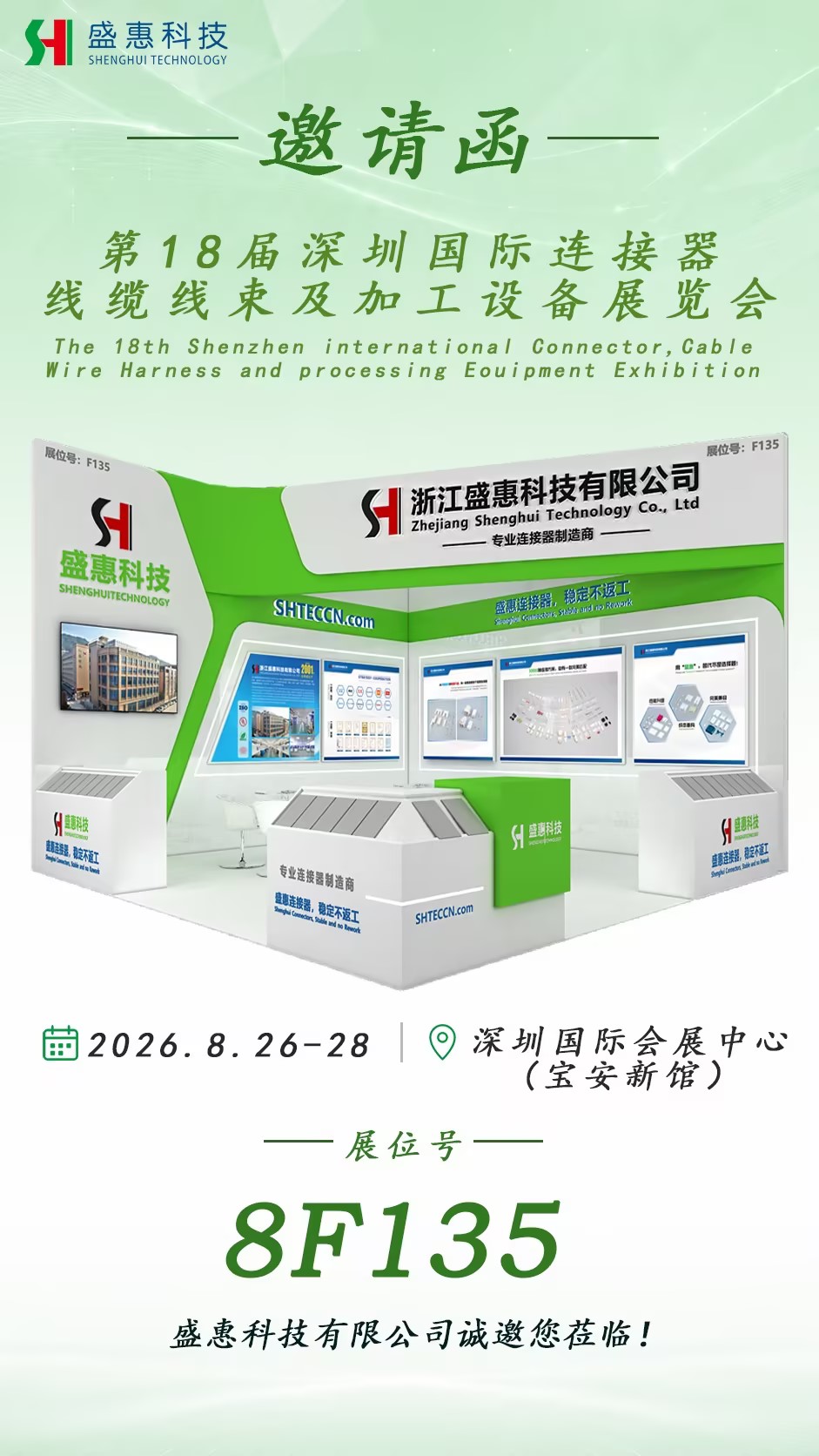
The Shenzhen Connector Exhibition Is Coming | Meet Shenghui Technology at Booth F135, Hall 8
The 18th Shenzhen International Connector, Cable, Wire Harness and Processing Equipment Exhibition is just around the corner. See you in Shenzhen! ? Date: August 26–28 ? Venue: Shenzhen World Exhibition & Convention Center (Bao’an) ? Booth: F135, Hall 8 Shenghui Technology has specialized in connector development and manufacturing for many years. We offer both standard products and customized solutions to meet the needs of projects across different industries. At the exhibition, we...

How to Choose the Right Wire Harness Terminal Connector
Choosing the right wire harness terminal connector is essential for building a safe and reliable electrical system. A connector that looks suitable may still fail if it does not match the wire size, electrical load, working environment, or assembly method. Check the Electrical Requirements Start by looking at the required current and voltage. The connector must safely handle the electrical load. If the terminal is too small or the contact design is weak, resistance may increase and cause heat...
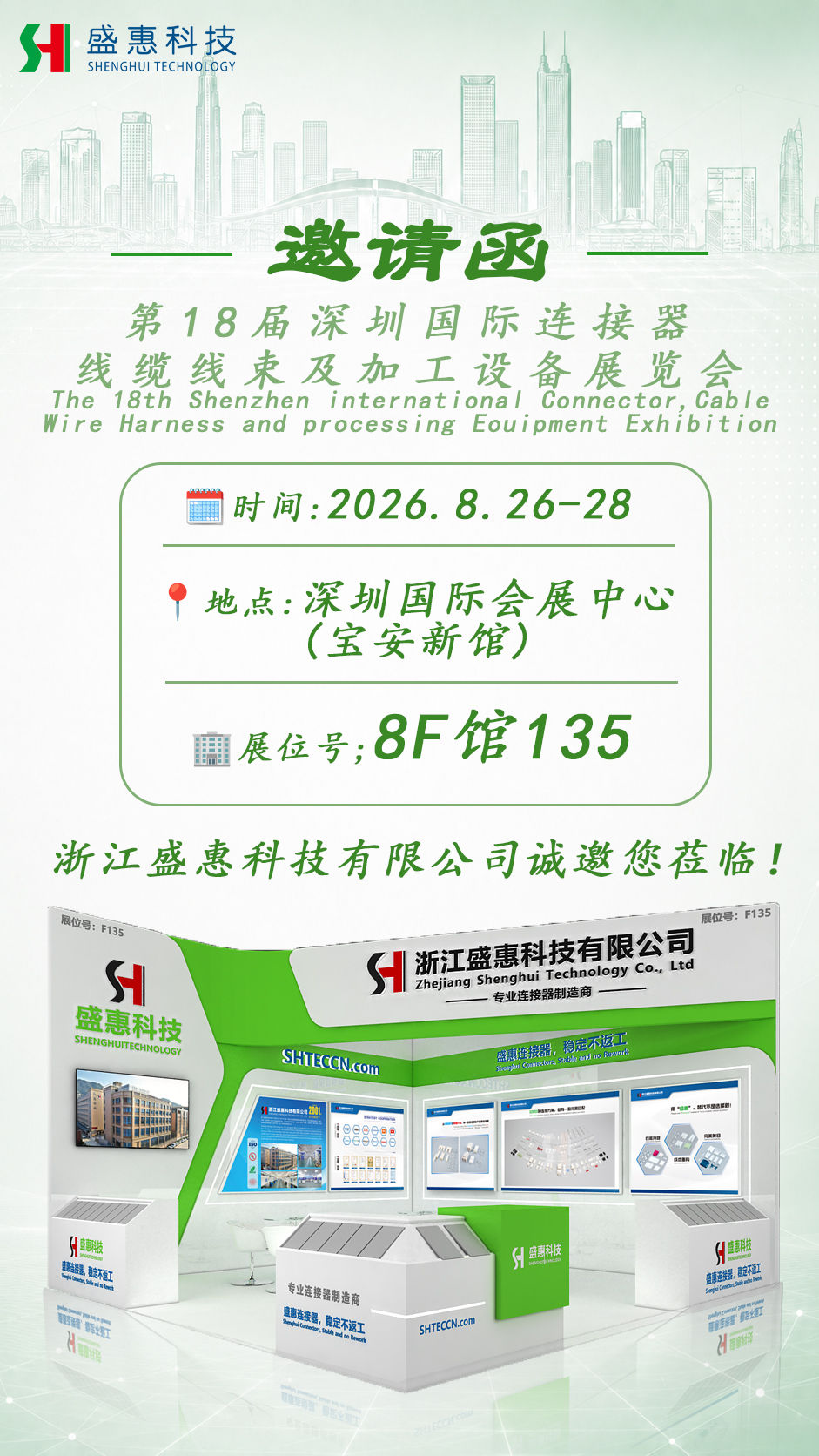
Meet Us at the Shenzhen Connector Exhibition | Shenghui Technology Is Waiting for You
Meet Us at the Shenzhen Connector Exhibition | Shenghui Technology Is Waiting for You The 18th Shenzhen International Connector, Cable, Wire Harness and Processing Equipment Exhibition is just around the corner. Shenghui Technology is ready and looks forward to meeting our customers and industry partners in Shenzhen! ⏰ Date: August 26–28, 2026 ? Venue: Shenzhen World Exhibition & Convention Center (Bao’an) ? Booth: F135, Hall 8 We develop and manufacture a wide range of connectors....

Meet Us in Shenzhen | Shenghui Technology Invites You to the Connector Exhibition
The 18th Shenzhen International Connector, Cable, Wire Harness and Processing Equipment Exhibition will take place from August 26 to 28, 2026, at the Shenzhen World Exhibition & Convention Center (Bao’an). You can find Shenghui Technology at Booth F135 in Hall 8. At the exhibition, we will showcase a range of connector products and application solutions. Visitors can view our product samples up close and speak directly with our technical and sales teams about product selection, custom...

How to Choose the Right Terminal Soft Sheath for Your Application
Choosing the right terminal soft sheath is important for safety, durability, and production efficiency. Although it is a small component, it directly affects how well the terminal area is insulated and protected in real working conditions. The first thing to consider is size and shape. The sheath must match the terminal structure correctly. If it is too loose, it may not stay in place. If it is too tight, installation may become difficult or the sheath may deform. Different terminal designs may...

Where Are Terminal Hard Sheath Products Used?
Terminal hard sheath products are used in many industries because electrical terminals often need reliable insulation and mechanical protection. These rigid protective parts help cover the terminal area, reduce exposure, and keep wiring connections safer and more organized. As a result, they are widely used in systems that require stable and durable electrical connections. One of the most common application areas is wire harness manufacturing. In wire harnesses, terminals must stay protected,...

Whether a connector is reliable and durable depends on every step of the production process.
At Shenghui Technology, connector terminals are first formed at high speed using precision stamping equipment. Our proven stamping process ensures stable and consistent dimensions across every batch, laying a solid foundation for product quality. After stamping, the products do not move directly to the next stage. Instead, every piece undergoes CCD vision inspection. The equipment automatically checks the appearance and dimensions, quickly detecting and removing defects such as deformation,...

Common Applications of Household Appliances Terminal Connectors
Household appliances terminal connectors are widely used in modern home appliances to create safe and reliable internal electrical connections. As appliances become smarter and more compact, these connectors play an even more important role in power distribution, signal transfer, and module integration. One major application is in washing machines. Terminal connectors are used to connect motors, pumps, sensors, door locks, control boards, and valves. Because these products work under vibration...
 Catalog
Privacy statement: Your privacy is very important to Us. Our company promises not to disclose your personal information to any external company with out your explicit permission.
Fill in more information so that we can get in touch with you faster
Privacy statement: Your privacy is very important to Us. Our company promises not to disclose your personal information to any external company with out your explicit permission.