


RFQ
Privacy statement: Your privacy is very important to Us. Our company promises not to disclose your personal information to any external company with out your explicit permission.

Why Board To Board Connectors Matter in Compact Electronics
Board to board connectors are important for compact electronics because they allow multiple printed circuit boards to connect in a clean, space-saving, and reliable way. As electronic devices become smaller and more functional, internal space becomes more limited. Engineers need efficient interconnection solutions, and direct PCB connection is one of the most practical options. Many modern devices use more than one circuit board. A product may have separate PCBs for power control,...

SH Technology Connectors: Tested with a 750°C Glow Wire
The flame-retardant performance of a connector’s plastic housing directly affects the safety of the equipment. Test reports are important, but actual performance under high-temperature conditions matters even more. At SH Technology, we manufacture our connector housings in-house. From raw material selection to injection molding, every step is completed and controlled in our own workshop. After molding, every batch undergoes CCD visual inspection to check dimensions and appearance. Any...

What Features Should a High-Quality Wire To Wire Connector Have?
A high-quality wire to wire connector should do much more than simply join two wires. In modern electrical and electronic systems, connectors must deliver stable conductivity, strong mechanical performance, easy assembly, and reliable durability under real operating conditions. For manufacturers and buyers, understanding these features helps ensure better product selection and long-term system performance. One of the most important features is stable electrical contact. The terminal design...

Common Wire-to-Board Connector Applications
Wire-to-board connectors are widely used in many industries because they provide a simple and reliable way to connect wires to printed circuit boards. Their versatility makes them suitable for products ranging from small consumer devices to larger industrial systems. One of the most common application areas is consumer electronics. Devices such as printers, speakers, display units, routers, battery-powered equipment, and small control devices often use wire-to-board connectors for internal...

Where Are Terminal Soft Sheath Products Commonly Used?
Terminal soft sheath products are used in many industries where electrical terminals need flexible insulation and basic mechanical protection. As electrical systems become more compact and complex, the need to protect connection points becomes even more important. One of the most common application areas is automotive wiring. Vehicles contain many terminal connections in lighting systems, battery lines, switches, sensors, and control modules. These connections often work under vibration, heat,...
Let’s take a look at how connectors are made!
After the plastic housings are fed into the equipment, a CCD camera scans each one to check its orientation and position. Only qualified housings move on to the pin insertion process. The insertion machine automatically inserts the pins according to preset parameters, ensuring high speed and precise positioning. After insertion, the equipment checks the pin positions and assembly condition again, automatically separating any defective products. From CCD inspection of the plastic housings to...

What Materials Are Used in Wire Harness Terminal Connectors?
The performance of a wire harness terminal connector depends greatly on its materials. Because the connector must carry current, maintain contact pressure, resist corrosion, and provide insulation, each material plays an important role in overall quality and service life. Conductive Terminal Materials The metal terminal is usually made from copper alloy materials. Copper is widely used because it has excellent electrical conductivity. However, pure copper is relatively soft, so manufacturers...

How to Choose the Right Terminal Hard Sheath for Your Application
Choosing the right terminal hard sheath starts with matching it to the correct terminal type and size. If the sheath does not fit the terminal properly, it may reduce insulation coverage, affect installation, or weaken connection reliability. That is why dimensional compatibility is always the first point to check. The second factor is material. Different applications require different levels of rigidity, wear resistance, and environmental performance. For general electrical use, standard...

What Materials Are Used in Terminal Connectors?
The performance of a terminal connector depends heavily on the materials used to make it. Because the connector must carry electrical current, remain mechanically stable, resist corrosion, and provide insulation, each material plays a specific role in overall performance. The conductive part of a terminal connector is usually made from copper or copper alloy. Copper is widely used because of its excellent electrical conductivity, which helps reduce energy loss and heat generation. However, pure...
In-House Manufacturing for Consistent Quality
Shenghui Technology operates its own injection molding and CCD visual inspection workshops. Key processes, from product molding to appearance inspection, are completed in-house. Automated injection molding equipment supports both mass production and customized orders, ensuring stable capacity and flexible production scheduling. After molding, products are inspected by CCD systems to identify appearance and detail defects, reducing manual inspection errors and improving consistency. In-house...

How Does a Household Appliances Terminal Connector Work?
A household appliances terminal connector works by creating a stable electrical path between wires and internal components inside a home appliance. Its job is to carry power or signals safely while keeping the connection secure, insulated, and easy to assemble. The core of the connector is the metal contact. When the terminal is properly inserted or mated, the metal surfaces touch with enough pressure to allow current or signals to pass smoothly. This connection powers or controls parts such as...

How to Choose the Right Board To Board Connector for Your Application
Choosing the right board to board connector is an important step in electronic product design. A small connector can have a major impact on PCB layout, assembly quality, space usage, and long-term reliability. To make the right choice, designers should consider both electrical and mechanical requirements. One key factor is pitch, which is the distance between adjacent contacts. Smaller pitch connectors allow higher contact density and support compact product design. However, they also require...

Common Applications of Wire To Wire Connectors in Modern Industry
Wire to wire connectors are used in many industries because they provide a practical and reliable way to join wires in electrical systems. As products become more advanced and wiring structures become more complex, the need for safe, efficient, and serviceable connections continues to grow. From small electronic devices to large industrial machines, wire to wire connectors play an important role in modern product design. One of the largest application areas is the automotive industry. Modern...
Birthday Wishes, Shenghui Warmth
Recently, Shenghui Technology held an employee birthday gathering in the company hall to send warm wishes to colleagues celebrating their birthdays. Drinks, fruit, snacks, and other refreshments were prepared on site. Everyone sat together, enjoyed the food, and chatted in a relaxed and lively atmosphere. In daily work, everyone is busy at their own positions. Whether in production, quality control, R&D, or sales, every part of the company’s progress depends on the dedication and hard...

What Is a Wire-to-Board Connector?
A wire-to-board connector is an electrical connector used to link wires directly to a printed circuit board. It creates a secure path for power, signals, or data between the cable side and the PCB side of a product. Although it is a small component, it plays a major role in the overall reliability, safety, and assembly efficiency of many electronic devices. In modern products, internal wiring must often connect batteries, motors, sensors, switches, displays, or power modules to a circuit board....
Day 2 of Exhibition Remains Red-Hot | Shenghui Technology Booth Packed with Visitors
Electronica Shanghai is in full swing! The booth stays bustling on the second exhibition day. We’d like to express our sincere gratitude to all new and long-term clients, as well as industry partners, for taking the time to visit Shenghui Technology’s booth. Our full lineup of connectors and newly upgraded products have won wide recognition from customers thanks to solid craftsmanship and versatile compatibility. Many guests examined samples side by side, inquired about product selection,...
Showtime! Shenghui Technology at electronica Shanghai – Full Connector Range & New Releases On-Site
The three-day electronica Shanghai exhibition opens its doors today! We at Shenghui Technology are here with our latest products and great offers. We’ve brought our complete line of connectors to the booth, plus brand-new upgraded models we’ve just launched this year. You can check out all our standard in-stock items, as well as new designs built for new equipment and working environments. All physical samples are available for close viewing, side-by-side comparison and testing. We’ve...

How Does a Wire Harness Terminal Improve Connection Reliability?
A wire harness terminal improves connection reliability by creating a stable and controlled contact point between a wire and an electrical component. In any electrical system, reliable connection is essential. If the terminal connection becomes loose, corroded, or unstable, the entire system may suffer from power loss, signal interruption, or overheating. One of the main ways a wire harness terminal improves reliability is through proper contact design. Instead of relying on bare wires or...

Exhibition Countdown: 2 Days to Go|Shenghui Technology New Products Coming Soon
electronica China 2026 is about to open, with only 2 days left until the exhibition begins. Shenghui Technology is now making final preparations, and we look forward to meeting both new and existing customers at the event. At this exhibition, Zhejiang Shenghui Technology will present a full range of connector products, including wire-to-wire, wire-to-board, board-to-board and other commonly used series. Visitors will be able to take a closer look at our product structures, specifications...
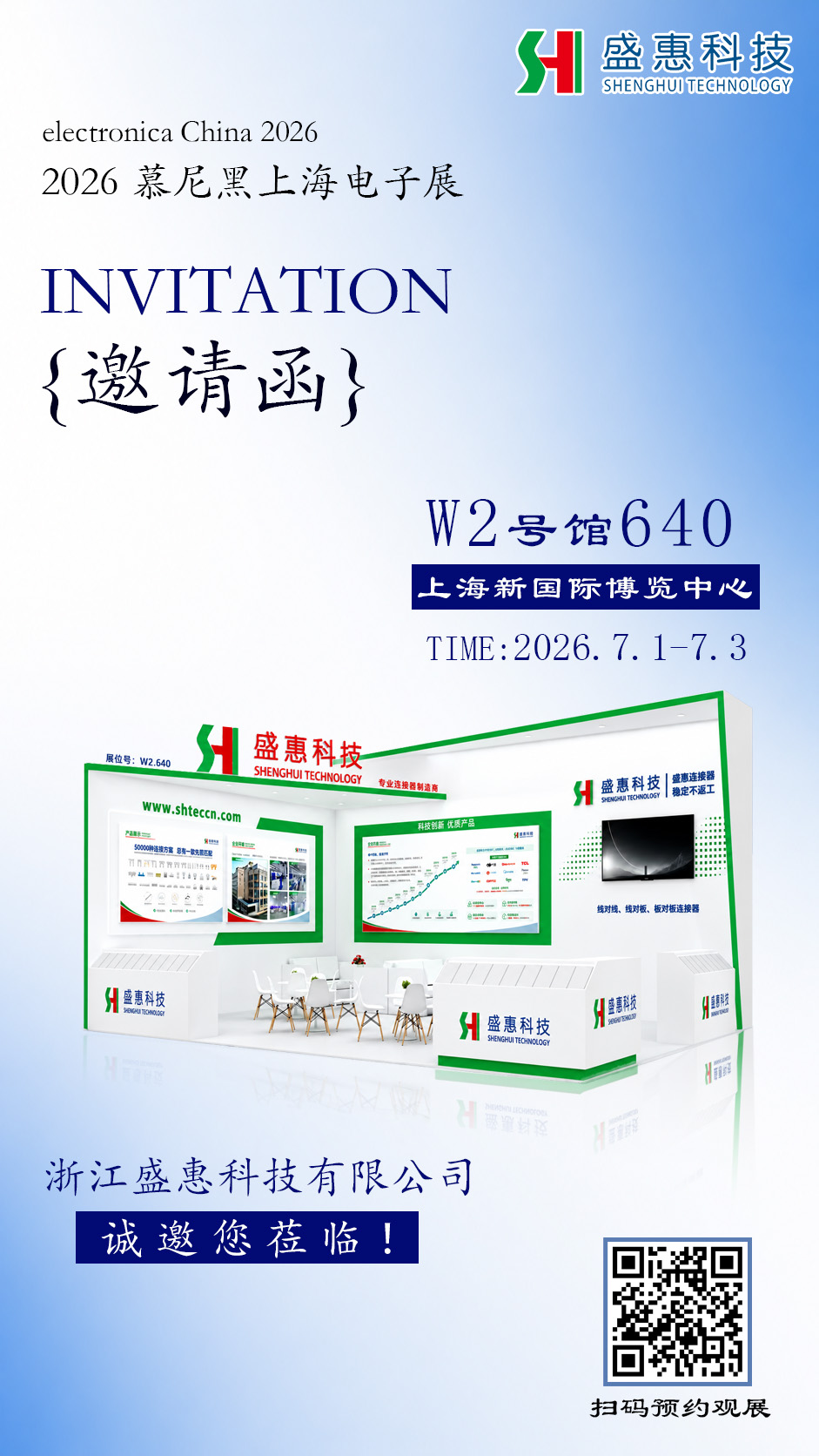
An Exhibition Invitation from Shenghui Technology
From July 1 to 3, 2026, electronica China will be held at the Shanghai New International Expo Centre. Shenghui Technology will participate in this exhibition, with our booth located at W2.640. We warmly welcome you to visit us on site. At this exhibition, Shenghui Technology will showcase a range of connector products and related application solutions, mainly focusing on common application fields such as home appliances and consumer electronics. We look forward to communicating face to face...

What Materials Are Used in Terminal Soft Sheath Products?
The performance of a terminal soft sheath depends greatly on its material. Since the sheath must provide insulation, flexibility, and environmental protection, selecting the right material is an important part of product design. One of the most common materials is PVC. PVC is widely used because it offers good electrical insulation, reasonable flexibility, and low cost. It is suitable for many standard applications such as household appliances, general wiring, and consumer electrical...

Connecting the Future — Shenghui Technology Looks Forward to Meeting You in Shanghai
Connectors may be small and easily overlooked in many electronic products, but they play an important role in the stability of the entire device. From project development to mass production, customers need not only the right product model, but also long-term support from the supplier in sampling, coordination, delivery, and quality control. From July 1 to 3, 2026, Shenghui Technology will participate in electronica China in Shanghai, with our booth located at W2.640. At this exhibition, we...

See You in Shanghai This July — Visit Shenghui Technology and Talk Connectors with Us
For many connector products, photos and specifications can only provide a general idea. To determine whether a product is truly suitable, it is still important to examine the actual sample, compare its structure, and discuss the application requirements. From July 1 to 3, 2026, Shenghui Technology will participate in electronica China. We will bring a variety of connector products and samples for visitors to view up close. Our team will also be available to discuss product selection,...

What Types of Wire Harness Terminal Connectors Are Used in Different Industries?
There are many types of wire harness terminal connectors, because different industries require different levels of electrical performance, mechanical strength, and environmental protection. Choosing the right type is important for system reliability and production efficiency. Crimp Terminal Connectors Crimp terminal connectors are among the most common types. In this design, the wire is crimped to a metal terminal and then inserted into a connector housing. This type is popular because it is...
 Catalog
Privacy statement: Your privacy is very important to Us. Our company promises not to disclose your personal information to any external company with out your explicit permission.
Fill in more information so that we can get in touch with you faster
Privacy statement: Your privacy is very important to Us. Our company promises not to disclose your personal information to any external company with out your explicit permission.